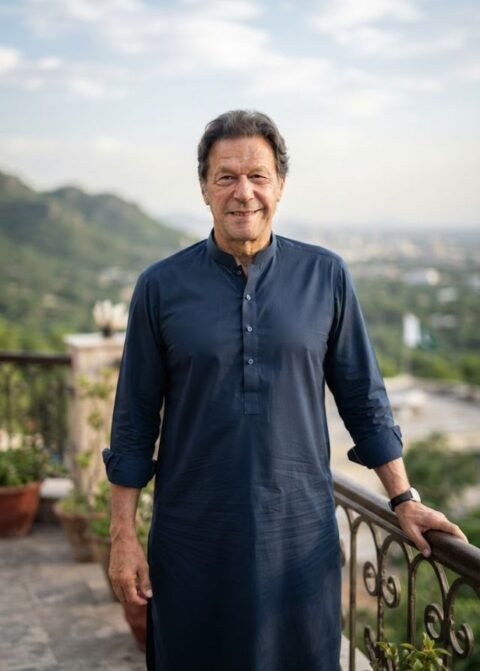
Imran Khan (full name Imran Ahmad Khan Niazi) is a Pakistani politician, philanthropist and former international cricketer. He captained Pakistan to its only Cricket World Cup title in 1992, founded the Pakistan Tehreek-e-Insaf (PTI) party in 1996, and served as the 22nd Prime Minister of Pakistan from 2018 to 2022. This Imran Khan biography covers his early life, family, education, cricket career, charity work, political rise, time in office and the legal cases he faces today.
Imran Khan Quick Facts
| Full name | Imran Ahmad Khan Niazi |
|---|---|
| Date of birth | 5 October 1952 |
| Place of birth | Lahore, Punjab, Pakistan |
| Parents | Ikramullah Khan Niazi (civil engineer) and Shaukat Khanum |
| Family roots | Niazi Pashtun tribe of Mianwali |
| Education | Aitchison College Lahore; Royal Grammar School Worcester; Keble College, Oxford (BA, Philosophy, Politics and Economics, 1975) |
| Cricket role | Right-arm fast bowler and all-rounder; Pakistan captain |
| Biggest cricket achievement | Won the 1992 Cricket World Cup as captain |
| Political party | Pakistan Tehreek-e-Insaf (PTI), founded 25 April 1996 |
| Prime Minister of Pakistan | 18 August 2018 – 10 April 2022 |
| Spouses | Jemima Goldsmith (1995–2004), Reham Khan (2015), Bushra Bibi (2018–present) |
| Children | Two sons, Sulaiman Isa Khan and Kasim Khan |
| Charity work | Shaukat Khanum Memorial Cancer Hospital, Namal University |
Early Life and Family Background
Imran Khan was born on 5 October 1952 in Lahore. His father, Ikramullah Khan Niazi, was a civil engineer, and his family belongs to the Niazi Pashtun tribe, long settled in Mianwali in north-western Punjab. His mother, Shaukat Khanum, came from the Burki Pashtun family of Jalandhar, which had already produced well-known cricketers, including his cousins Javed Burki and Majid Khan. Imran was the only son in a family with four sisters, and he grew up in a comfortable, middle-class household in Lahore.
Education: Aitchison College to Oxford
He studied at Aitchison College and Cathedral School in Lahore before moving to England, where he attended the Royal Grammar School Worcester. He then went to Keble College, Oxford, graduating in 1975 with a degree in Philosophy, Politics and Economics (PPE). At Oxford he also captained the university cricket team, which helped him combine top-level cricket with his studies.
Imran Khan’s Cricket Career
Imran Khan made his Test debut for Pakistan against England on 3 June 1971, aged 18. At first he was a raw, wayward fast bowler. Over the next decade he turned himself into one of the fastest and most skilful bowlers in the world, and a dependable middle-order batsman. He played county cricket in England for Worcestershire and Sussex, which sharpened his game further.
He is widely credited with mastering and popularising reverse swing, a technique that later became a trademark of Pakistani fast bowling through players such as Wasim Akram and Waqar Younis, both of whom developed under his captaincy.
Captain of Pakistan
Imran was first appointed Pakistan captain in 1982. A natural leader, he unified a talented but divided dressing room, backed young players and insisted on neutral umpires, a reform cricket later adopted worldwide. He retired after the 1987 World Cup, but returned in 1988 at the request of President Zia-ul-Haq and led the team for four more years.
The 1992 Cricket World Cup Win
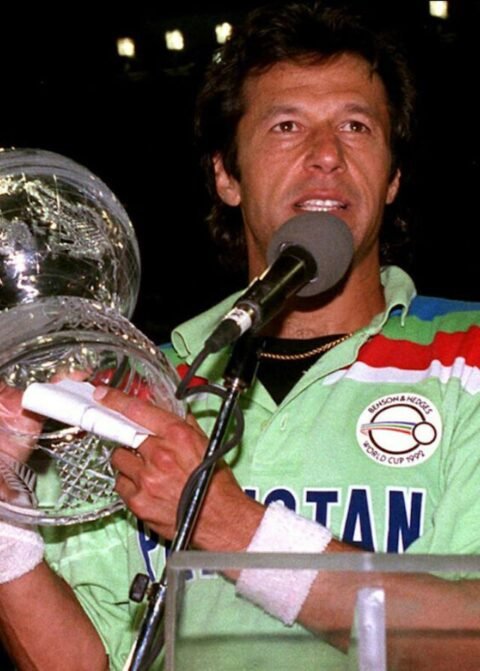
The defining moment of his sporting life came at the 1992 Cricket World Cup in Australia and New Zealand. After a poor start, Pakistan were close to elimination. Imran famously told his players to fight “like cornered tigers”, and the team won its remaining matches to reach the final. On 25 March 1992, Pakistan beat England by 22 runs at the Melbourne Cricket Ground to lift the trophy for the first time. Imran retired from international cricket soon after, at the age of 39.
Career Statistics and Records
| Format | Matches | Runs | Wickets | As captain |
|---|---|---|---|---|
| Test cricket | 88 | 3,807 (avg 37.69) | 362 (avg 22.81) | 48 Tests, 14 wins |
| One-Day Internationals | 175 | 3,709 | 182 | 139 ODIs, 75 wins |
He is one of the few players in Test history to have scored more than 3,000 runs and taken more than 300 wickets, placing him among the great all-rounders of his era alongside Ian Botham, Kapil Dev and Richard Hadlee. He was named a Wisden Cricketer of the Year in 1983 and was inducted into the ICC Cricket Hall of Fame in 2009.
Philanthropy and Social Work
Shaukat Khanum Memorial Cancer Hospital
After his mother died of cancer in 1985, Imran Khan set out to build Pakistan’s first specialist cancer hospital where poor patients could be treated free of charge. Using his fame, he raised money through public campaigns at home and abroad. The Shaukat Khanum Memorial Cancer Hospital and Research Centre opened in Lahore in 1994, and a second hospital later opened in Peshawar. A large share of its patients receive treatment at no cost.
Namal University and Other Work
In 2008 he founded Namal College (now Namal University) in his ancestral district of Mianwali, originally as an associate college of the University of Bradford, to bring quality higher education to a rural area. He served as Chancellor of the University of Bradford from 2005 to 2014, and set up the Imran Khan Foundation in 2006 for welfare and disaster-relief work.
Political Career and Pakistan Tehreek-e-Insaf (PTI)
Imran Khan entered politics by founding Pakistan Tehreek-e-Insaf (Pakistan Movement for Justice) on 25 April 1996, promising to fight corruption and build a fairer, welfare-focused state. Success was slow. PTI won no seats in the 1997 election, and in 2002 Imran was the party’s only winner, taking the Mianwali seat in the National Assembly. PTI boycotted the 2008 election.
Rise of PTI (2011–2018)
The turning point came with a huge rally at Minar-e-Pakistan in Lahore on 30 October 2011, which drew large numbers of young and urban voters. In the 2013 general election PTI became one of the country’s main parties by vote share and formed the provincial government in Khyber Pakhtunkhwa. In 2014 he led a long sit-in (dharna) in Islamabad alleging rigging in that election. After the 2016 Panama Papers leak, he campaigned and petitioned the courts against Prime Minister Nawaz Sharif, who was disqualified by the Supreme Court in 2017.
Prime Minister of Pakistan (2018–2022)
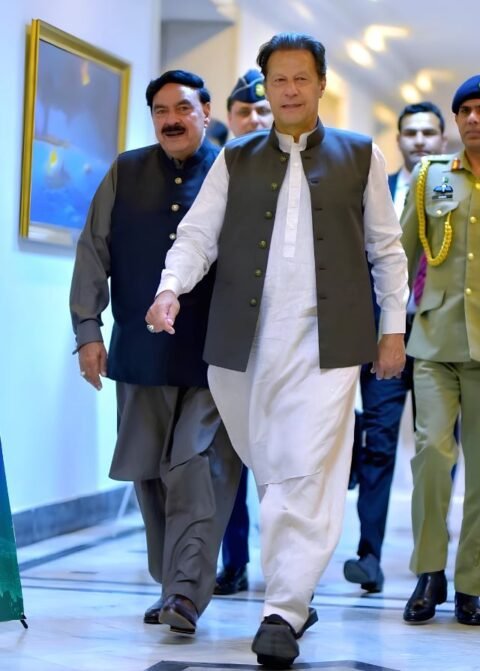
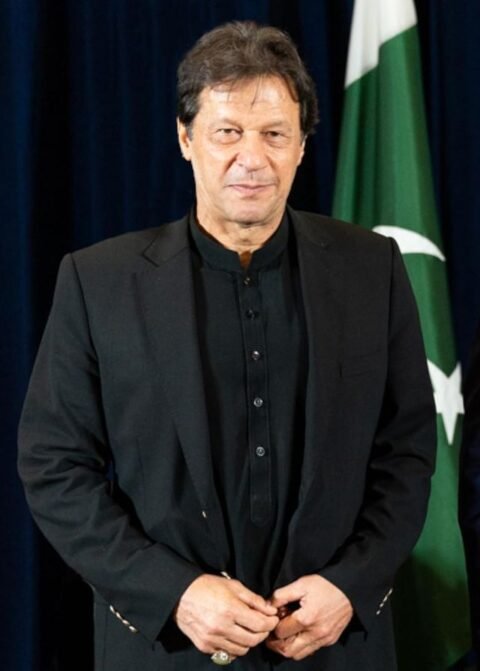
In the July 2018 general election PTI emerged as the largest party, and Imran Khan won all five National Assembly seats he contested, a first in Pakistan’s history. He was sworn in as the 22nd Prime Minister of Pakistan on 18 August 2018, promising a “Naya Pakistan” modelled on the ideal of a welfare state.
Key Policies and Initiatives
- Ehsaas Programme: a large social-safety-net scheme including cash transfers for low-income families, expanded during the COVID-19 pandemic.
- Sehat Sahulat Programme (Sehat Card): health insurance giving families free treatment at listed hospitals.
- 10 Billion Tree Tsunami: a national tree-planting drive building on the Billion Tree project in Khyber Pakhtunkhwa.
- Kartarpur Corridor: opened in November 2019 to give Sikh pilgrims from India visa-free access to Gurdwara Darbar Sahib in Kartarpur.
- COVID-19 “smart lockdown”: targeted local restrictions intended to protect daily-wage earners from a full shutdown.
- Naya Pakistan Housing and the Single National Curriculum in education.
His government also faced serious challenges, including high inflation, a balance-of-payments crisis that led to an IMF programme in 2019, and criticism from opponents and the media over economic management and press freedom.
Foreign Policy
On the world stage, Imran Khan spoke repeatedly about Islamophobia, notably in his 2019 address to the UN General Assembly, and argued for a political settlement in Afghanistan. During the February 2019 India–Pakistan crisis, he ordered the return of a captured Indian Air Force pilot as a gesture of de-escalation. His visit to Moscow on 24 February 2022, the day Russia invaded Ukraine, drew international attention.
No-Confidence Vote and Removal from Office
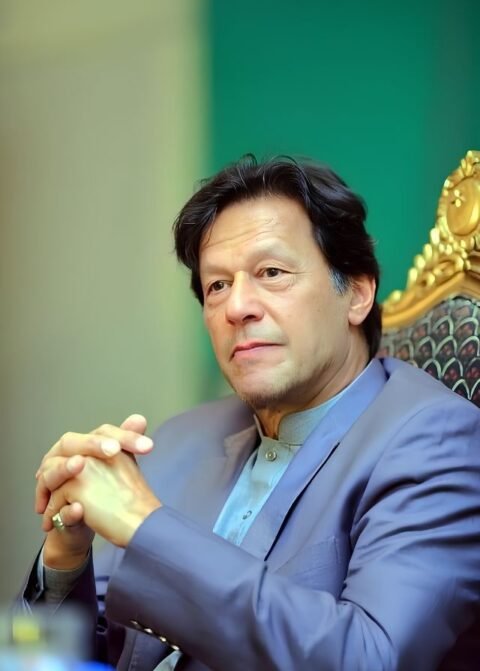
On 10 April 2022, Imran Khan became the first Prime Minister of Pakistan to be removed through a parliamentary no-confidence motion, after allies left his coalition. He alleged that his removal was the result of a foreign-backed conspiracy, pointing to a diplomatic cable (the “cipher”). The United States and his political opponents rejected that claim. Shehbaz Sharif succeeded him as Prime Minister.
After Office: Protests, Arrests and Court Cases
After leaving power, Imran Khan held mass rallies across the country demanding early elections. On 3 November 2022, he was shot in the leg during an attack on his protest march in Wazirabad, and recovered after treatment.
On 9 May 2023 he was arrested at the Islamabad High Court in the Al-Qadir Trust case, triggering nationwide protests, including attacks on military buildings. The Supreme Court declared that arrest unlawful two days later. On 5 August 2023 he was convicted in the first Toshakhana (state gifts) case, arrested at his Zaman Park home in Lahore, and disqualified from holding public office. He was later moved to Adiala Jail in Rawalpindi and stepped down as PTI chairman in December 2023, with Gohar Ali Khan taking over.
Major Cases and Verdicts
| Case | Verdict | Current status |
|---|---|---|
| Cipher case | 10 years (January 2024) | Overturned on appeal, June 2024 |
| Toshakhana-I case | 14 years (January 2024) | Sentence suspended on appeal |
| Iddat (marriage) case | 7 years (February 2024) | Overturned on appeal, July 2024 |
| Al-Qadir Trust case | 14 years (17 January 2025) | Under appeal |
| Toshakhana-II case | 17 years (20 December 2025) | Under appeal |
Imran Khan and PTI say the cases are politically motivated. The government and the military deny this and say the cases follow due legal process. In the February 2024 general election, PTI was barred from using its “bat” symbol, and candidates it backed contested as independents. They nonetheless won the largest number of seats of any group.
Where Is Imran Khan Now?
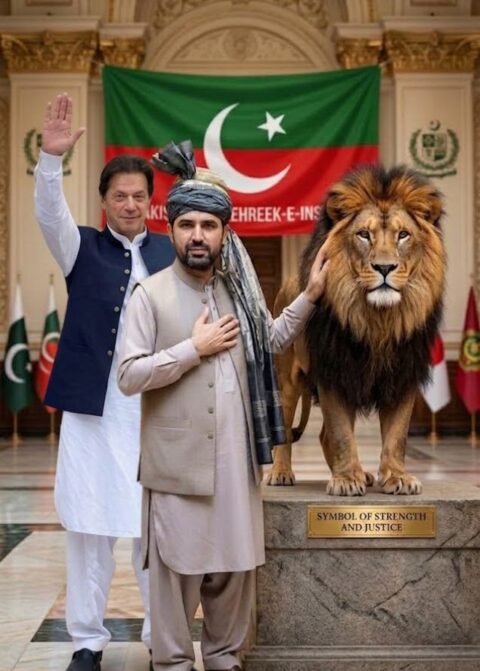
As of early October 2026, Imran Khan remains imprisoned at Adiala Jail in Rawalpindi, more than three years after his August 2023 arrest. His family and lawyers have raised concerns about his health, including a serious loss of vision in his right eye reported in 2026. In August 2026 the Supreme Court ordered his transfer to hospital for treatment, but he was taken to a government hospital for a short visit and then returned to jail. No release date has been set. This section was last updated in October 2026.
Personal Life, Wives and Children
Imran Khan has been married three times:
- Jemima Goldsmith: married in 1995 and divorced in 2004. They have two sons, Sulaiman Isa Khan (born 1996) and Kasim Khan (born 1999), who grew up in London.
- Reham Khan: a British-Pakistani journalist. They married in January 2015 and divorced in October 2015.
- Bushra Bibi: married in February 2018. She has also been convicted in some of the same cases, which she and PTI dispute.
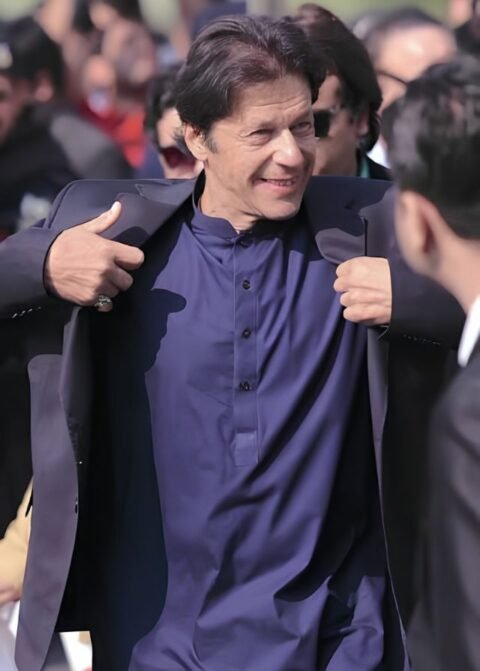
Known for his personal discipline and fitness, Imran Khan has spoken often about how his Islamic faith deepened in later life. He usually appears in public wearing the national dress, the shalwar kameez.
Books by Imran Khan
- Imran: The Autobiography of Imran Khan (1983)
- All Round View (1988)
- Indus Journey: A Personal View of Pakistan (1990)
- Warrior Race: A Journey Through the Land of the Tribal Pathans (1993)
- Pakistan: A Personal History (2011)
Awards and Honours
- Pride of Performance (1983)
- Wisden Cricketer of the Year (1983)
- Hilal-i-Imtiaz (1992)
- ICC Cricket Hall of Fame (2009)
Imran Khan’s Legacy
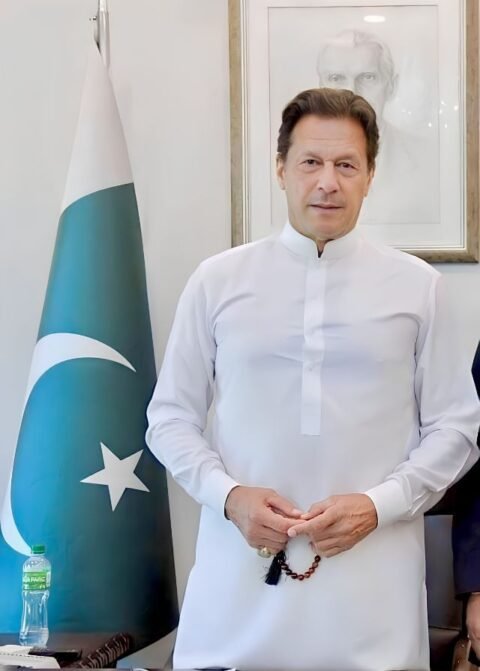
Few Pakistanis have shaped both sport and politics the way Imran Khan has. To cricket fans he remains the captain who turned Pakistan into world champions and changed fast bowling. To millions of supporters he is a symbol of anti-corruption politics and a voice for ordinary Pakistanis. His critics question his record in government and his confrontations with state institutions. Either way, he remains one of the most influential and closely followed figures in Pakistan’s modern history.
Frequently Asked Questions About Imran Khan
What is Imran Khan’s full name?
His full name is Imran Ahmad Khan Niazi.
When and where was Imran Khan born?
He was born on 5 October 1952 in Lahore, Punjab, Pakistan.
When did Imran Khan win the Cricket World Cup?
He captained Pakistan to victory in the 1992 Cricket World Cup, beating England in the final in Melbourne on 25 March 1992.
When was Imran Khan Prime Minister of Pakistan?
He served as Prime Minister from 18 August 2018 until 10 April 2022, when he was removed by a no-confidence vote.
Who founded PTI?
Imran Khan founded Pakistan Tehreek-e-Insaf on 25 April 1996 and led it as chairman until December 2023.
Who is Imran Khan’s wife?
He is married to Bushra Bibi. His earlier marriages were to Jemima Goldsmith and Reham Khan.
How many children does Imran Khan have?
He has two sons with Jemima Goldsmith: Sulaiman Isa Khan and Kasim Khan.
Is Imran Khan in jail?
Yes. As of October 2026 he is held at Adiala Jail in Rawalpindi, serving sentences in the Al-Qadir Trust and Toshakhana-II cases, which he is appealing.
Looking for pictures? Browse our gallery of Imran Khan pictures and wallpapers.